



SaaS Pricing Negotiation: 4 Email Templates to Save 15–40%
Most SaaS companies price their software online, yet 70% of enterprise customers negotiate discounts. Even small and mid-market teams can save 15–40% by simply asking. The difference between list price and negotiated price is often built into the vendor's margin.
This guide provides battle-tested email templates for negotiating SaaS pricing in four common scenarios: annual commitment discounts, multi-year deals, competitive leverage, and contract renewal renegotiation. We'll also share the framework that makes these negotiations successful.
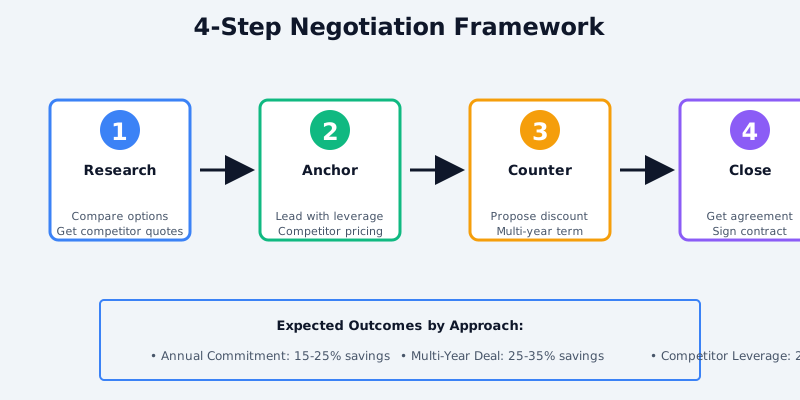
Why SaaS Vendors Are Willing to Negotiate
SaaS companies prioritize customer acquisition and retention metrics more than unit economics. A vendor would rather negotiate 20% off than lose a deal entirely. Here's why:
Get the free SaaS Pricing Playbook
How 500+ SaaS tools really price themselves. Pricing tier breakdowns, hidden costs, negotiation tactics. PDF-ready guide delivered to your inbox.
Free forever. No spam. Unsubscribe anytime.
- Customer Acquisition Cost (CAC): SaaS vendors spend 30–50% of revenue on sales. Closing a deal 20% cheaper is still better than losing it entirely.
- Annual Recurring Revenue (ARR) targets: At quarter-end, sales teams are incentivized to close any deal. This is when negotiation leverage is highest.
- Churn prevention: Keeping an existing customer at a lower price is cheaper than replacing them with a new customer.
- Market positioning: Enterprise competitors often get 30–50% discounts. Mid-market customers can leverage competitive bids.
- Volume discount psychology: Committing to annual or multi-year terms reduces vendor revenue risk, justifying discounts.
The golden rule: Higher commitment (multi-year vs. monthly) earns bigger discounts. Willingness to pay upfront earns discounts. Competitive alternatives earn discounts.
Negotiation Framework: The BATNA Approach
Before sending any email, establish your BATNA (Best Alternative To Negotiated Agreement):
- Research alternatives: What are 2–3 competing tools at similar price points? Budget a few hours to evaluate them.
- Get competitive quotes: Request pricing from 2 competitors. You don't need to switch; you just need credible alternatives.
- Calculate break-even cost: What discount would make you indifferent to switching? (Example: 20% off your current vendor vs. 3 months' switching cost for a competitor.)
- Set walkaway price: Below this price, you'll use a competitor instead. Make this your bottom line.
- Choose your leverage: Annual commitment, multi-year term, or competitive alternative?
With a strong BATNA, you negotiate from confidence, not desperation.
Template 1: The Annual Commitment Discount Request
When to use: After 2–3 months of monthly billing, when you're happy with the vendor and want to reduce costs.
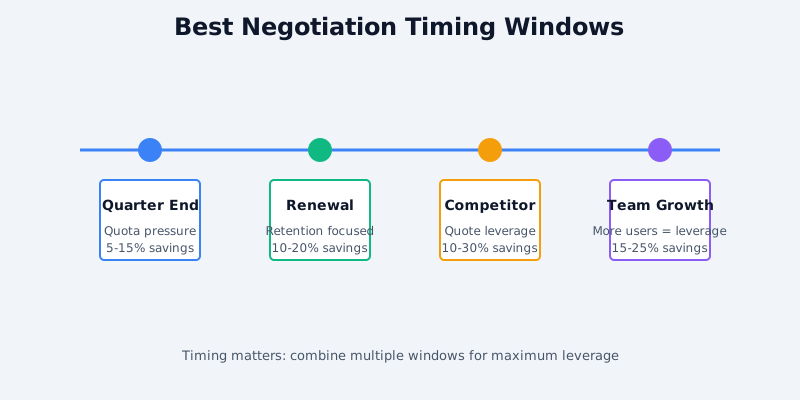
Best timing: Mid-quarter (not quarter-end when vendors are closing deals) or during renewal windows.
Expected discount: 15–25% off monthly rates.
```
Subject: Let's talk annual billing for [Company Name] account
Hi [Sales Rep Name],
We've been using [Product Name] for [2–3 months] and it's become essential to our [team/workflow]. Our team loves [specific feature], and we see long-term value.
We'd like to commit to an annual contract to lock in our usage and planning. To make this work financially, we need a pricing adjustment. Our current monthly cost is $X, and we'd need to get this down to $Y (approximately a 20% reduction) on annual billing to approve the investment internally.
Can we explore an annual plan that works for both of us?
Thanks,
[Your Name]
```
Why this works:
- Opens with positive sentiment (we love your product)
- States your intention clearly (annual commitment)
- Gives a specific number and discount threshold
- Leaves room for negotiation
Expected vendor response: They'll likely counter at 10–15% if they want the deal. You can accept, push back to 20%, or ask for additional features as a sweetener instead of pure price reduction.
---
Template 2: The Multi-Year Lock-In Deal
When to use: When you're ready to commit long-term (2–3 years) and want significant savings.
Best timing: During contract renewal or when approaching a tie-in decision.
Expected discount: 25–35% off list price.
```
Subject: 3-year commitment opportunity for [Company Name]
Hi [Sales Rep/Account Manager Name],
We're pleased with [Product Name]'s performance on [specific metric: e.g., time savings, team satisfaction, workflow improvements]. Our team is now planning our annual budget, and we'd like to explore a multi-year commitment to simplify planning and potentially reduce costs for both of us.
We're interested in locking in a 3-year agreement at a reduced rate. Here's what makes sense for us:
- Current monthly cost: $X
- Target annual rate: $Y (equivalent to ~30% discount on list price)
- Commitment: 3 years with annual billing
This type of deal is common with our other vendors, and we'd be open to a [custom integration / SSO implementation / additional seat block] as part of the package.
Are you open to exploring this structure? If so, I'd like to get this in front of your pricing team this week.
Thanks,
[Your Name]
```
Why this works:
- Frames multi-year as a win for vendor (predictable ARR)
- States a specific, reasonable discount (30% is defensible for 3-year terms)
- Offers additional value (integration, SSO) as a sweetener
- Creates urgency (wants response this week)
Expected vendor response: They'll likely need to escalate to pricing/finance. If they say yes, you've just saved 30% × 3 years = 90% of one year's cost. If they counter at 20%, you've still saved significantly.
---
Template 3: The Competitive Leverage Approach
When to use: When you have credible competitive quotes and are genuinely evaluating alternatives.
Best timing: At contract renewal or when actively exploring alternatives.
Expected discount: 20–40% (leveraging competition).
Important: This only works if you have actual competing quotes. Generic "we got quotes" threats are ineffective.
```
Subject: Pricing feedback and competitive evaluation for [Product Name]
Hi [Account Manager Name],
We're in the process of renewing our [Product Name] contract, and we're also evaluating alternatives to ensure we're getting the best value for our team's needs.
We've gathered proposals from [Competitor 1] and [Competitor 2], and while [Product Name] has advantages [e.g., customer support, specific features], the pricing gap is material. Here's what we're seeing:
- [Product Name] (current): $X/month
- [Competitor 1]: $Y/month (Z% savings)
- [Competitor 2]: $W/month (V% savings)
We'd prefer to stay with [Product Name] because of [reasons: integration with our existing stack, team familiarity, feature X]. But to justify the continued investment to leadership, we'd need to match or be within 5% of the competitive pricing.
Can you work with your pricing team to provide a renewal quote that's competitive? We need to finalize this decision by [specific date].
Thanks,
[Your Name]
```
Why this works:
- Shows you've done homework (credible competitive quotes)
- Expresses preference to stay (gives vendor the advantage)
- Specifies the gap and what's needed to close it
- Creates deadline (forces decision)
Expected vendor response: They'll likely ask for the competitor quotes to "ensure they're apples-to-apples." Share redacted versions showing pricing only (not feature comparisons). If they match or beat the competitor, you've won. If they won't budge, you have a real alternative to switch to.
---
Template 4: The Renewal Renegotiation
When to use: At contract renewal when your usage or team size has changed. Most vendors offer renewal discounts to reduce churn.
Best timing: 60 days before renewal (renewal teams have more flexibility than new-customer sales).
Expected discount: 10–20% as a retention discount.
```
Subject: [Product Name] renewal discussion – usage and pricing
Hi [Renewal Manager Name],
Our [Product Name] subscription renews on [date], and I'd like to discuss both our contract terms and pricing for the next year.
Over the past year, our usage has [changed significantly / remained stable], and we've identified both things working great [feature/integration X] and areas we'd optimize [feature/need Y]. Here's where we stand:
Current Contract:
- Seats: [number]
- Monthly cost: $X
- Annual commitment: [yes/no]
For Renewal, We're Considering:
- Adjusting seats to [number] (as our team [grew/stabilized])
- Extending to a 2-year term if pricing is favorable
- Budget allocated: $Y/year
We're happy with [Product Name] and want to continue, but we need to ensure the renewal pricing reflects market rates. Can you provide a renewal quote that reflects:
- Our updated usage/seat count
- Loyalty/retention discount
- Multi-year savings if we commit to 2 years?
We'd like to finalize this by [date].
Thanks,
[Your Name]
```
Why this works:
- Signals you're happy (reduces churn risk)
- Provides specific data (usage changes, seat count)
- Shows willingness to extend (2-year term is incentive for vendor)
- Sets clear timeline
Expected vendor response: Renewal teams are trained to retain customers. They'll often offer 10–20% retention discount automatically or when asked. If they don't, you have leverage to negotiate because you're an existing, happy customer.
---
Advanced Negotiation Tactics
Tactic 1: Bundle Services Instead of Price
If a vendor won't budge on price, ask for value-adds:
- Custom integration development
- Priority support or dedicated account manager
- Additional features (SSO, advanced reporting)
- Training and onboarding services
- Extended contract term with price lock
Example: "If you can't move on price, can you include custom Slack integration + priority support?"
Tactic 2: Negotiate in Phases
Don't ask for everything at once. Lock in a multi-year deal at 20% off, then negotiate specific add-ons separately.
Example: Year 1 deal at $X, then add "custom integrations package" for year 2.
Tactic 3: Get Everything in Writing
Once you agree to a discount, ensure the contract reflects it. Don't rely on verbal agreements; email confirmation isn't sufficient. Have legal review any custom terms.
Tactic 4: Use Year-End and Quarter-End Pressure
Sales teams are under intense quota pressure at quarter-end. A deal closing on March 31 vs. April 1 is massively different for vendors. If you can time a negotiation for late quarter, you have leverage.
Tactic 5: Buy Together, Negotiate Bigger
If you're evaluating SaaS with other teams (e.g., marketing and sales both need analytics tools), negotiate as a company. Vendors give bigger discounts for company-wide contracts.
---
Common Objections and Counter-Responses
Vendor: "Our pricing is fixed. I can't adjust it."
Response: "I understand. But we've seen similar pricing flexibility from [Competitor 1]. If you can't match it, we may need to explore alternatives. Can you escalate this to your manager or pricing team?"
---
Vendor: "You're getting a great price already. Most customers pay [higher price]."
Response: "That's helpful context. If most customers pay [X], the list price should reflect that. Can you tell me what the actual range is for companies our size and usage level?"
---
Vendor: "We can only adjust pricing if you commit to 3 years."
Response: "That's workable. What discount would a 3-year term earn? And can we include a usage-adjustment clause so we're not locked into a seat count if our team shrinks?"
---
Vendor: "We're not able to move until you're at [usage threshold]."
Response: "OK. What's the threshold, and when could we revisit pricing after we hit it? Can we lock in a future price adjustment in writing now?"
---
When NOT to Negotiate
Some scenarios make negotiation inadvisable:
- You're the small fish: If you're paying $500/month and a competitor is $400/month, your leverage is weak. The time spent negotiating isn't worth the $100 savings.
- You have no alternatives: If there's no real alternative, negotiating signals you're not serious.
- During onboarding/free trial: Wait until you're committed before negotiating. Too early signals deal-seeking behavior.
- For completely free tiers: Free software rarely negotiates. The margin doesn't exist.
---
Sample Negotiation Timeline
Here's a realistic timeline for negotiating an annual contract:
Week 1: Evaluate alternatives, get 2 competing quotes (research phase)
Week 2: Send Template 1 or 2 to your vendor contact
Week 3: Vendor responds with initial counter-offer (usually 5–10% vs. your 20% ask)
Week 4: You counter at 15%; vendor responds at 12%
Week 5: You accept 15% or negotiate a different sweetener (features, support)
Week 6: Legal/contract review, sign
This timeline assumes monthly follow-up. Many vendors respond within 24–48 hours if incentivized.
---
Conclusion
SaaS pricing is rarely final. Vendors build negotiation room into their pricing because customer retention is worth more than list-price margins. The best negotiators:
- Do their homework (research alternatives, get quotes)
- Are specific (state exact discount thresholds, not vague requests)
- Show commitment (multi-year terms, budget, usage plans)
- Have leverage (competitive alternatives or genuine walkaway point)
- Stay professional (don't threaten; present facts)
Most teams can save 15–25% with a single, well-crafted email. Teams willing to commit to multi-year terms can save 30–40%. The time investment pays back in weeks.
For help evaluating SaaS alternatives and pricing before you negotiate, explore our detailed tool comparisons. Compare pricing across [your category] tools side by side with our pricing calculators.