


Enterprise vs Startup SaaS Pricing: Why 10–50x Cost Difference?
Salesforce costs $165–$660 per user per month. HubSpot costs $50–$3,200 per month for the entire team. Slack costs $12.50 per user per month. Asana costs $13.49 per user per month. But enterprise SaaS like Salesforce Service Cloud, SAP, or Oracle can cost $500k–$5M annually for a 100-person company.
The price gap isn't just markup. It reflects fundamental differences in product design, support, customization, compliance, and business models. This guide breaks down why enterprise SaaS is 10–50x more expensive and when that premium is actually justified.
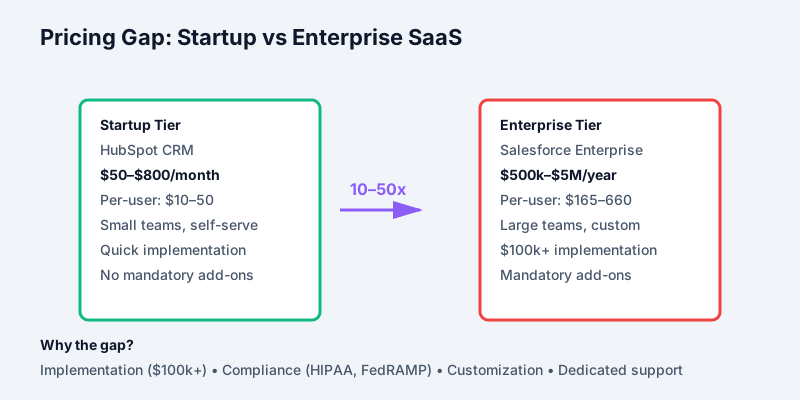
The Price Gap: Real Examples
CRM Market
Get the free SaaS Pricing Playbook
How 500+ SaaS tools really price themselves. Pricing tier breakdowns, hidden costs, negotiation tactics. PDF-ready guide delivered to your inbox.
Free forever. No spam. Unsubscribe anytime.
Startup/SMB Option: HubSpot
- Team size: 20 people
- Annual cost: $3,200/month × 12 = $38,400/year
- Cost per person: $1,920/year
Enterprise Option: Salesforce
- Team size: 20 people
- Annual cost: $495/user × 20 × 12 = $118,800/year
- Cost per person: $5,940/year
- Premium: 3.1x more expensive
Email Marketing
Startup: Mailchimp
- 100k contacts, 1M emails/month
- Annual cost: $500/month × 12 = $6,000/year
Enterprise: Marketo (Adobe)
- Same volume (100k contacts, 1M emails/month)
- Annual cost: $1,250/month minimum + $50/user add-ons
- Typical annual cost: $20,000–$40,000/year
- Premium: 3–7x more expensive
HR Management
Startup: BambooHR
- 500 employees
- Annual cost: $8/employee × 500 = $4,000/month = $48,000/year
Enterprise: Workday
- 500 employees
- Annual cost: $150–$300/month per employee = $75,000–$150,000/month = $900,000–$1.8M/year
- Premium: 19–38x more expensive
The Workday example is extreme, but illustrates the scale of enterprise pricing. Why would a company pay $900k when they could use BambooHR for $48k?
Why Enterprise SaaS Costs 10–50x More
1. Per-Seat vs. Volume-Based Pricing
Startup SaaS (per-seat pricing):
- Asana: $13.49/user/month
- Slack: $12.50/user/month
- Monday.com: $12/user/month
As teams grow, cost scales linearly. A 100-person team pays 100x more than a 1-person user.
Enterprise SaaS (license + volume-based):
- Salesforce: $165–$660/user/month (negotiable)
- Oracle: $50k–$500k annually (negotiable)
- SAP: $100k–$1M+ annually (negotiable)
Enterprise vendors negotiate total spend, not per-seat pricing. A 100-person company might pay $500k while a 500-person company pays $2M (not 5x, but 4x). Pricing is bucketed by company size, employee count, and revenue.
Impact: Startups scale predictably; enterprises negotiate heavily, but base pricing is higher.
---
2. Implementation, Setup, and Onboarding Costs
Startup SaaS:
- Self-service onboarding: Free or $0
- Admin training: 8 hours @ $100/hr = $800
- Data migration: 10 hours = $1,000
- Total: $1,800 one-time
Enterprise SaaS:
- Mandatory implementation partner: 200–500 hours @ $250–$350/hr = $50k–$175k
- Admin and developer training: 100–200 hours @ $200/hr = $20k–$40k
- Data migration and ETL: 100–300 hours @ $300/hr = $30k–$90k
- Custom configuration and development: 200–500 hours @ $250/hr = $50k–$125k
- Testing and QA: 100–200 hours = $30k–$60k
- Total: $180k–$490k one-time
Impact: Enterprise implementation is 100–300x the cost of startup onboarding. This isn't built into monthly fees-it's an upfront cost.
---
3. Support and SLAs (Service Level Agreements)
Startup SaaS:
- Standard support: Email only, 24–48 hour response
- Premium support: Email + chat, 4–8 hour response
- Enterprise support: Phone + chat + Slack, 1–2 hour response
- Cost: Included in Pro/Business tiers or +$50–$500/month
Enterprise SaaS:
- Standard support: Email, 24 hour response, 99% uptime SLA
- Premium support: 8-hour response, 99.5% uptime SLA
- Mission-critical support: 1-hour response, 99.99% uptime SLA, dedicated TAM (Technical Account Manager)
- Cost: Built into enterprise contracts + $10k–$50k/month for dedicated support
An oracle enterprise contract with a $500k annual license often includes a $50k–$100k/year support add-on for true 24/7 availability. Startups get 8-hour support for free.
Impact: Enterprise customers need mission-critical reliability. Downtime costs them millions. Startups can tolerate 2-hour outages.
---
4. Customization and Integration Complexity
Startup SaaS:
- API: Free with standard limits (100k calls/month)
- Pre-built integrations: Zapier, native Slack/Teams
- Customization: Low-code workflows (built-in)
- Cost: Included
Enterprise SaaS:
- API: Unlimited with premium tiers
- Custom integrations: Require implementation partner ($20k–$100k per integration)
- Customization: Custom code, custom objects, custom workflows
- Example: Salesforce wants to integrate with SAP? That's a 3–6 month, $100k–$300k project
- Cost: $50k–$500k in professional services
Enterprise systems often need to integrate with 10–20 legacy systems. Each integration requires custom development. Startup SaaS is designed for plug-and-play via APIs.
Impact: Enterprise complexity requires specialized expertise and custom development. Startups are cloud-native and API-first.
---
5. Data Volume, Storage, and Performance
Startup SaaS:
- Typical limits: 1M–10M records
- Storage: 100 GB–1 TB included
- Additional storage: $1–$10/month per TB
- API rate limits: 1k–10k calls/minute
Enterprise SaaS:
- No practical record limits (unlimited)
- Storage: 100 TB–1 PB (custom)
- Performance: Dedicated infrastructure, custom CDN
- API rate limits: Unlimited with guaranteed SLA
- Cost: Bundled into enterprise contract
Salesforce customers with 100M+ records need dedicated infrastructure and custom performance tuning. Asana assumes most teams have < 100k tasks. The cost difference reflects the infrastructure needed.
---
6. Compliance, Security, and Governance
Startup SaaS:
- SOC 2 Type II compliance: Standard
- GDPR/CCPA: Built-in
- Data residency: Multiple regions
- Audit logs: 90 days retention
- Cost: Included
Enterprise SaaS:
- FedRAMP compliance (for government contracts): $100k–$500k+ in certifications
- HIPAA (healthcare): Requires dedicated infrastructure and audit procedures
- PCI-DSS (payment processing): Requires external validation
- FISMA (federal information systems): Mandatory for US federal contractors
- Data residency: Custom per country/jurisdiction
- Audit logs: 7–10 year retention
- Cost: $50k–$500k annually in compliance infrastructure + mandatory professional services
If a healthcare company wants Salesforce with HIPAA compliance, that's not just a checkbox-it's a completely separate, audited infrastructure. Similarly, a government contractor needing FedRAMP certification must use a FedRAMP-authorized vendor.
Impact: Enterprise compliance isn't a feature; it's mandatory infrastructure.
---
7. Business Model and Customer Acquisition Cost (CAC)
Startup SaaS:
- Customer acquisition: Self-serve, word-of-mouth, content marketing, PPC ads
- CAC: $200–$1,000 per customer
- Payback period: 2–6 months
- Sales model: Product-led growth (free trial, freemium, self-signup)
Enterprise SaaS:
- Customer acquisition: Enterprise sales team, multi-month sales cycles, RFP processes
- CAC: $50,000–$500,000 per customer (sales team, RFPs, POCs, legal reviews)
- Payback period: 18–36 months
- Sales model: Top-down, relationship-driven, RFP-driven
An enterprise sales rep at Salesforce costs $200k+/year (salary + commission + overhead). If they close 3 deals per year at $100k each = $300k revenue, that CAC is $200k. Startup SaaS can acquire customers at 1/100th the CAC via viral growth.
Impact: Enterprise pricing must cover massive sales and marketing costs. Startup pricing is lean.
---
8. Product Roadmap and Customization Depth
Startup SaaS:
- Feature parity across all customers
- Road map driven by feature requests, community voting
- Customization: Low-code/no-code only
- Release cycle: Weekly or bi-weekly updates
Enterprise SaaS:
- Feature customization per customer (custom fields, custom workflows, custom UX)
- Road map driven by largest contracts ($1M+ customers)
- Development: Custom development teams per customer
- Release cycle: Quarterly or annual
- Example: Salesforce maintains separate codebases and customizations for 10,000+ customers
Each Salesforce customer with a $5M contract gets a dedicated release manager and custom feature development. This isn't scalable-it's why enterprise pricing is so high.
Impact: Enterprise is bespoke; startup is standardized.
---
Total Cost of Ownership: 3-Year Comparison

Let's calculate total cost including licensing, implementation, support, and training.
Scenario: 100-Person Company, 3-Year Contract
HubSpot (Startup SaaS):
- Licensing: $3,200/month × 12 × 3 = $115,200
- Implementation: 40 hours @ $150/hr = $6,000
- Training: 20 hours @ $125/hr = $2,500
- Support upgrades: $0 (included)
- 3-Year TCO: $123,700
- Per-person annual: $412
Salesforce (Enterprise SaaS):
- Licensing: $495/user × 100 × 12 × 3 = $1,782,000
- Implementation: 200 hours @ $300/hr = $60,000
- Admin training: 80 hours @ $200/hr = $16,000
- Ongoing support: $50k/year × 3 = $150,000
- Custom integrations (to existing systems): 3 integrations × $50k = $150,000
- 3-Year TCO: $2,158,000
- Per-person annual: $7,193
Cost difference: Salesforce is $2,034,300 more (17.5x higher)
---
Why Would a Company Choose Salesforce?
Despite the staggering cost, enterprises choose Salesforce because:
- Scale justification: A 100-person company with $10M revenue pays $2.1M for Salesforce. But a 500-person company with $100M revenue pays $6M-scaling the system to manage $100M in revenue. The cost per revenue dollar drops dramatically.
- Mandatory capabilities: Salesforce has features (advanced customization, 7-year audit logs, HIPAA compliance, FedRAMP certification) that HubSpot doesn't offer. If you need them, price is irrelevant-it's the only option.
- Enterprise lock-in: Once 500 employees are trained on Salesforce and 50 custom workflows are built, switching is impossible. Salesforce knows this and prices accordingly.
- Integration necessity: Legacy enterprise systems (SAP, Oracle, NetSuite, Workday) integrate natively with Salesforce. A company with existing Oracle infrastructure must use Salesforce CRM because custom integration would cost $500k+.
- Stakeholder mandates: "Our CEO/CFO/CTO worked at Salesforce and mandates we use it" is a real reason. Enterprise buying decisions are often driven by executive relationships, not ROI.
---
When to Choose Startup vs Enterprise SaaS
Choose Startup SaaS if:
- Team size < 100 people
- Budget-constrained (VC-funded or bootstrapped)
- Using cloud-native tech stack (no legacy systems)
- Need implementation within weeks (not months)
- Willing to build custom integrations via APIs and Zapier
- Don't have mandatory compliance requirements (HIPAA, FedRAMP)
Choose Enterprise SaaS if:
- Team size > 500 people
- Budget unlimited (Fortune 500 company)
- Integrated with legacy systems (SAP, Oracle, Workday)
- Need 99.99% uptime SLA and 24/7 support
- Require custom development and dedicated support team
- Have mandatory compliance (government contracts, healthcare, finance)
- Executive mandate or existing relationship with vendor
The sweet spot: Mid-market companies (50–500 people) should evaluate both. Startup SaaS often wins because implementation is fast and costs are predictable. Enterprise SaaS wins if mandatory compliance or legacy integration is required.
---
The Future: Enterprise SaaS Becoming More Affordable
Positive trend: Enterprise vendors are introducing "mid-market" tiers. Salesforce now offers "Essentials" ($165/user) for small teams, down from $500+/user. Microsoft Teams costs $6/user/month, not $100. Workday is testing lower-tier SMB offerings.
As cloud vendors (AWS, Azure, Google Cloud) commoditize infrastructure, the cost to run enterprise features drops. Expect enterprise SaaS pricing to become more accessible to mid-market companies over the next 3–5 years.
---
Conclusion
Enterprise SaaS is expensive because it bundles:
- Higher per-user licensing
- Mandatory implementation (100–300x onboarding costs)
- Premium support and SLAs
- Custom integrations and development
- Compliance and security certification
- High customer acquisition cost recovery
Startup SaaS is cheap because it's self-serve, standardized, cloud-native, and compensates for lower pricing with high volume.
Neither is "wrong"-they serve different customers with different requirements. A startup paying $50k/year for HubSpot is optimizing correctly. A Fortune 500 company paying $5M/year for Salesforce Enterprise + Veeva + Netsuite is also optimizing correctly.
For detailed comparisons, explore our CRM category and SaaS pricing guides. Use our pricing calculators to estimate true TCO including implementation and support costs.