




Intercom vs Zendesk Pricing
Intercom and Zendesk are built for the same mission - managing customer conversations at scale - but they attack the problem from opposite directions. Zendesk is traditional support ticketing with workflow automation baked in. Intercom is conversational engagement that blurs the line between marketing, sales, and support. That philosophical difference shows up immediately in pricing: Intercom charges per seat on a simple tier structure; Zendesk charges per agent on a more granular plan system.
This matters because at scale, those seat-based charges compound differently. A 10-person support team at Intercom can cost anywhere from $390–$1,390 per month depending on features. The same team on Zendesk runs $550–$1,150 per month. But once you factor in Intercom's AI add-ons (Fin), the picture shifts fast.
We'll break down every tier, run TCO scenarios from small teams to enterprises, and tell you which one actually wins when you account for real-world usage.
Quick Pricing Snapshot
Get the free SaaS Pricing Playbook
How 500+ SaaS tools really price themselves. Pricing tier breakdowns, hidden costs, negotiation tactics. PDF-ready guide delivered to your inbox.
Free forever. No spam. Unsubscribe anytime.
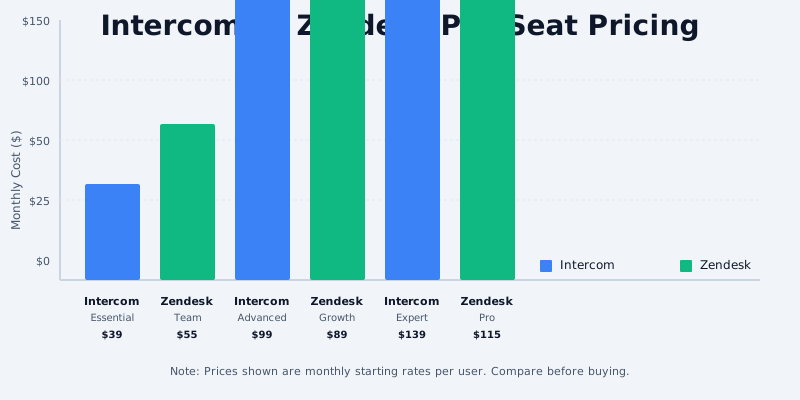
Intercom 2026 Pricing (per seat/month, billed annually):
- Essential: $39/seat/month
- Advanced: $99/seat/month
- Expert: $139/seat/month
- Fin AI: $0.99/resolution (extra on any plan)
- No free tier available
Zendesk Suite 2026 Pricing (per agent/month, billed annually):
- Suite Team: $55/agent/month
- Suite Growth: $89/agent/month
- Suite Professional: $115/agent/month
- Suite Enterprise: Custom pricing
- No free tier available
Neither platform offers a free tier, so there's no zero-cost bootstrap path. Both require a subscription from day one. The raw seat costs suggest Intercom is cheaper upfront, but the devil lives in the details - especially AI pricing.
Free Tier
Neither platform offers one. Zendesk and Intercom both start at paid plans. Zendesk's minimum is $55/agent/month on Suite Team. Intercom's minimum is $39/seat/month on Essential. That $16 difference per month appeals to price-conscious teams, but both require commitment.
If you're starting from zero budget, you'll want to look at Freshdesk, Helpscout, or another platform with a free or freemium tier. Neither of these contenders will work for the truly bootstrapped.
Essential vs Team (Entry Tier)
Once you decide to pay, the choice is between Essential (Intercom) and Suite Team (Zendesk).
Intercom Essential ($39/seat/month) gives you the core product: shared inbox for email and live chat, customer profiles with conversation history, basic automation (triggers and rules), and up to 10 team members. You get the Intercom API, Messenger customization, and integrations with 200+ apps via Zapier. What you don't get: AI-powered features, workflow builders, or advanced reporting. It is a clean, simple entry point.
Zendesk Suite Team ($55/agent/month) bundles email, live chat, voice, and social into a unified agent workspace. You also get a help center, basic AI bots (Zendesk's bot builder is included), and reporting. The big difference here is omnichannel - you're paying for Zendesk's ability to handle every channel in one view, whereas Intercom Essential is email and chat only.
At $16/seat more, Zendesk buys you voice and social support. If your customers reach you via phone or Twitter, Zendesk starts to look like the better deal. If you're email and in-app chat only, Intercom Essential saves $192/year per seat.
Winner at this tier: Intercom for lean, chat-first teams; Zendesk if you need multichannel.
Advanced vs Growth (Mid-Market)
Here the positioning flips.
Intercom Advanced ($99/seat/month) unlocks the platform's core differentiator: customer data activation. You get advanced automation (dynamic segment targeting, journey orchestration), custom attributes, source tracking, and Intercom's more sophisticated reporting. You also gain access to Intercom's full API and developer platform. Advanced is where Intercom's conversational CRM angle becomes real - this is where you can build personalized customer journeys triggered by behavior.
Zendesk Suite Growth ($89/agent/month) adds SLA management, advanced reporting via Explore (Zendesk's analytics tool), custom roles, and webhook triggers for deeper integrations. The workflows engine gets more powerful here. Growth is the tier where Zendesk stops being a ticket tool and starts feeling like a platform.
Intercom Advanced ($99) is $10 more per seat than Zendesk Growth ($89), but they solve different problems. Zendesk Growth is for teams that live in tickets and need powerful routing and automation. Intercom Advanced is for teams building customer engagement campaigns. The question is which playbook you're running.
Winner at this tier: Depends on your use case. Zendesk for automation-heavy ticket operations; Intercom for customer engagement and personalization.
Professional vs Expert (Enterprise)
Intercom Expert ($139/seat/month) is the top tier. You get everything: advanced customer data segmentation, custom event tracking, team permissions and audit logs, API access to all endpoints, and sandbox environments. You also get priority support and a dedicated success contact. This is the only Intercom tier that includes compliance features like SSO.
Zendesk Suite Professional ($115/agent/month) includes advanced reporting with Explore, SLA management, community forums, content blocks, and custom agent roles. Professional is positioned as the tier for teams running complex ticket workflows and needing advanced compliance features. Zendesk also offers Suite Enterprise (custom pricing) for very large organizations, which includes FedRAMP/HIPAA and enterprise SLA agreements.
At $139 vs $115, Intercom Expert costs 21% more per seat. Intercom includes more customer data capabilities and API access. Zendesk includes more compliance certifications and community features. For a 10-person team, that $240/month difference ($2,880/year) is material. For a 50-person team, it balloons to $12,000/year.
Winner at this tier: Zendesk on compliance and cost; Intercom for customer data depth.
The Fin Factor (AI Pricing)
Here's where the math breaks.
Both platforms have pivoted hard to AI. Intercom's bet is Fin AI, a copilot and bot resolution tool that handles customer questions automatically. Zendesk AI is included in base plans but limited; advanced AI features require add-ons.
Intercom Fin is billed per resolution at $0.99 per ticket resolved. That sounds cheap until you do the math. A 10-person team handling 500 tickets/month across Fin would add $4,950/year to their bill. At 1,000 tickets/month, that is $11,880/year. For a team running Fin heavily, the cost can exceed the base seat cost.
Zendesk AI (the advanced product, not the basic bots in Suite plans) starts at roughly $50/agent/month on top of your Suite plan. For a 10-person team, that is $6,000/year. It is also less granular - you pay per agent, not per resolution, so you get unlimited AI use once you've paid the subscription.
Which is cheaper depends on resolution volume. Light AI users (100–200 resolutions/month) will find Intercom Fin affordable. Heavy AI users (1,000+/month) will find Zendesk's flat fee more cost-effective.
Impact: AI can double your cost. Budget conservatively or you'll be shocked at invoice time.
Total Cost of Ownership (TCO)
Let's compare apples to apples: equivalent tiers, annual billing, no AI add-ons (we'll add those separately).
5 Seats/Agents
| Platform | Plan | Monthly | Annual |
|---|---|---|---|
| Intercom | Essential | $195 | $2,340 |
| Zendesk | Suite Team | $275 | $3,300 |
| Intercom | Advanced | $495 | $5,940 |
| Zendesk | Suite Growth | $445 | $5,340 |
At 5 people on entry plans, Intercom Essential saves $960/year. By Advanced/Growth, Zendesk pulls slightly ahead ($600/year cheaper).
10 Seats/Agents
| Platform | Plan | Monthly | Annual |
|---|---|---|---|
| Intercom | Essential | $390 | $4,680 |
| Zendesk | Suite Team | $550 | $6,600 |
| Intercom | Advanced | $990 | $11,880 |
| Zendesk | Suite Growth | $890 | $10,680 |
| Intercom | Expert | $1,390 | $16,680 |
| Zendesk | Suite Professional | $1,150 | $13,800 |
At 10 people on entry tiers, Intercom saves $1,920/year. On professional tiers, Zendesk saves $2,880/year. The break-even is somewhere in Advanced/Growth territory.
25 Seats/Agents
| Platform | Plan | Monthly | Annual |
|---|---|---|---|
| Intercom | Advanced | $2,475 | $29,700 |
| Zendesk | Suite Growth | $2,225 | $26,700 |
| Intercom | Expert | $3,475 | $41,700 |
| Zendesk | Suite Professional | $2,875 | $34,500 |
At 25 people, Zendesk is cheaper by $3,000–$7,200/year depending on tier. The gap widens at scale.
50 Seats/Agents
| Platform | Plan | Monthly | Annual |
|---|---|---|---|
| Intercom | Advanced | $4,950 | $59,400 |
| Zendesk | Suite Growth | $4,450 | $53,400 |
| Intercom | Expert | $6,950 | $83,400 |
| Zendesk | Suite Professional | $5,750 | $69,000 |
At 50 people, Zendesk saves $6,000–$14,400/year. That is enough to hire another person.
Hidden and Extra Costs
Both platforms hide costs beyond the seat/agent fee. Know what you're getting into.
AI Resolutions (Intercom Fin)
Intercom Fin is billed per resolution at $0.99. A "resolution" means Fin handled the customer question without human intervention.
For a 20-person team handling 2,000 customer questions/month with a 40% Fin resolution rate (800 resolutions), the bill is $9,600/year just for AI. That is equivalent to adding 2 Advanced seats ($99 × 24 months × 2 = $4,752) or 10 Expert seats' worth of AI budget.
Zendesk AI Add-ons
Zendesk's base AI (in Suite plans) is fairly basic - it can suggest articles or deflect simple questions. Real AI agent automation requires Zendesk AI (the product), starting at $50/agent/month.
A 20-person team running Zendesk AI costs $12,000/year extra - similar to Intercom Fin if resolution rates are high, but Zendesk includes unlimited usage once you've paid the fee.
Premium Integrations
Both platforms have hundreds of integrations. Many are free; some are not.
Intercom's top-tier integrations (Segment, some Zapier Pro connectors) can add $20–$50/month. Zendesk's advanced integrations (Salesforce real-time sync, some marketplace apps) are similarly priced.
Budget $20–$50/month if you're doing custom integrations. Both platforms will try to upsell third-party apps once you're committed.
Phone Support and Other Channels
Intercom's native phone support is part of Advanced and Expert plans. If you want robust phone ticketing, it is included.
Zendesk Talk (phone) is a separate add-on billed per minute. A team handling 500 minutes/month (roughly 2 hours/day) could add $10–$25/month.
Intercom includes phone; Zendesk charges for it. Another point in Intercom's favor for voice teams.
Feature Comparison: The Real Differences
Both platforms do support and engagement, but the operational experience is different.
| Feature | Intercom | Zendesk |
|---|---|---|
| Channels (core) | Email, Chat, Messenger | Email, Chat, Voice, Social |
| Ticket Routing | Basic rules | Advanced workflows + triggers |
| Customer Data | Built-in customer profiles and segments | Requires Zendesk Connect or middleware |
| AI (included) | Basic Fin (per-resolution cost) | Basic bots + AI Agent (paid add-on) |
| Reporting | Conversation analytics | Explore analytics tool |
| Phone Support | Included in Advanced+ | Separate add-on (Talk) |
| Compliance | SSO on Expert | HIPAA, FedRAMP on Enterprise |
| Workflow Automation | Segment-based journeys | Ticket-based triggers and macros |
| Community Features | None | Suite Team+ |
| API Maturity | Excellent | Excellent |
Zendesk is the ticket automation powerhouse. Intercom is the customer engagement platform that happens to do support.
When to Choose Intercom
Choose Intercom if:
- You're building customer journeys, not just handling tickets. Intercom's customer data platform, segmentation, and behavior-triggered campaigns are built for teams doing marketing + support fusion.
- You are small (under 10 people). Intercom Essential ($39/seat) vs Zendesk Team ($55/agent) saves real money in the beginning.
- You want AI included without per-minute charges. Intercom Fin is per-resolution; Zendesk Talk is per-minute. If you're doing phone support, Intercom bundles it.
- You prioritize conversational experience. Intercom is designed around conversations. The UI, the features, the philosophy - it all assumes you're talking to customers, not filing tickets.
- You need customer data activation. Behavioral triggers, segment-based campaigns, and customer lifetime value tracking are native to Intercom. Zendesk requires connectors to do this.
- You're not highly regulated. Intercom lacks FedRAMP and HIPAA certifications that Zendesk offers. If you're in healthcare or government, Zendesk is probably mandatory.
When to Choose Zendesk
Choose Zendesk if:
- Ticket automation is your core need. Zendesk's workflow engine, SLA management, and trigger-based routing are best-in-class for high-volume support teams.
- You need omnichannel from the start. Voice, social, email, chat - Zendesk handles them all in one unified workspace. Intercom is catching up but Zendesk is still the omnichannel leader.
- You're building complex ticket workflows. Custom objects, advanced roles, and conditional routing. If your support operation is sophisticated, Zendesk scales faster.
- You need HIPAA or FedRAMP compliance. Financial services, healthcare, government. Zendesk has these certifications; Intercom does not yet.
- You're at 20+ agents and want predictable AI costs. Zendesk AI is per-agent, so you know the cost ceiling. Intercom Fin is per-resolution, which can surprise you at scale.
- You live in the Zendesk ecosystem. Zendesk Sell (CRM), Zendesk Service, Zendesk Guide. If you're using multiple Zendesk products, the integration story is seamless.
- You have a large team. Zendesk's per-agent cost is lower at 20+ people. The curve favors Zendesk at scale.
Bottom Line
Intercom is cheaper per seat at the Essential tier ($39 vs $55) and wins on phone support bundling. But Zendesk's lower cost at scale, stronger automation, and omnichannel capabilities make it the better deal for most support teams at 20+ people. The AI math is murky: Intercom Fin is cheap per resolution if you have light AI usage, but expensive if you're automating heavily.
Pick Intercom if you're small, conversational, and doing customer engagement. Pick Zendesk if you're ticket-heavy, at scale, or regulated.
For a live side-by-side feature and pricing breakdown, see our full Intercom vs Zendesk comparison.