



Most SaaS Pricing is Negotiable - Especially Above $1K/Year
Here is what SaaS vendors do not tell you: almost every price is negotiable.
That sticker price on their website is a starting point, not a ceiling. Vendors have margin built into their tiering, and they will reduce it if you have leverage. Teams that negotiate SaaS contracts save 20-40% on average - sometimes more.
The challenge is knowing when to negotiate, what leverage points matter, and how to avoid leaving money on the table.
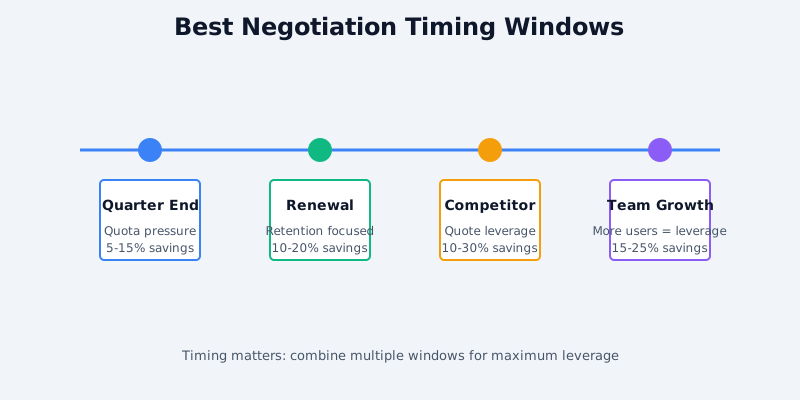
When to Negotiate: The Best Timing Windows
Get the free SaaS Pricing Playbook
How 500+ SaaS tools really price themselves. Pricing tier breakdowns, hidden costs, negotiation tactics. PDF-ready guide delivered to your inbox.
Free forever. No spam. Unsubscribe anytime.
Not every moment is equally good for negotiation. Timing matters because it affects how much the vendor cares about losing you.
End of Vendor's Quarter or Year
Vendors live by quota. If it is the last week of their quarter or fiscal year, your deal might push them over the line to hit targets. Sales teams with quota pressure will accept lower prices.
Action: Ask your sales contact when their fiscal year ends. Negotiate hard in the week before, and be prepared to sign quickly.
Your Contract Renewal Date
Renewal is the single best time to negotiate. The vendor already has you as a customer, so the conversation is not about acquisition - it is about retention. A sales team facing churn will move on pricing faster than they will on new logos.
Action: Do not auto-renew. Send a formal request for proposal (RFP) or quote renewal 60 days before expiration. Make it clear you are evaluating alternatives. This creates urgency.
When You Have a Competitor's Quote
Nothing focuses a vendor like an offer from their competitor at a better price. If you have an RFP response or quote from a similar tool, you have leverage.
Action: Get a written quote from a competitor first. Bring it to the incumbent vendor and say: "We like your tool, but Tool X offered this pricing. Can you match or beat it?" Most vendors will.
When You Are Growing (New Headcount or Usage)
If your team is growing and you need to add users or increase usage, you have negotiation leverage. The vendor wants to keep you, and they see revenue opportunity in your growth.
Action: Do not just buy the higher tier at list price. Tell your vendor: "We are doubling team size and moving from 10 to 20 users. What is the best pricing you can offer if we commit to annual?" Growth is leverage.
When You Have Multiple Stakeholder Approval
If your deal needs sign-off from the CFO or procurement team, use that as a reason to ask for better terms. "Procurement wants proof we got the best price" is a legitimate negotiation move.
Action: Tell your vendor: "To get internal approval, I need to show I negotiated the best possible terms. What discount can you offer?"
Preparation: Know Your Numbers Before You Negotiate
Walking into a negotiation unprepared is worse than not negotiating at all. Vendors smell weak preparation.
Build Your Usage Baseline
Pull your actual usage data from the current tool (if you are renewing) or make realistic projections (if it is new).
- Storage used (GB)
- Number of active users
- API calls or messages sent (if applicable)
- Number of projects, databases, or records
- Monthly commit volume or minutes used
This matters because hybrid-pricing tools will try to lock you into higher-than-necessary commitments. If you know you use 100GB of storage but can get by with 50GB on the new plan, you know where to negotiate.
Document Your Current Spend
Audit your full software stack. Most teams do not know how much they spend on SaaS annually. When you tell a vendor "We spend $250K on marketing stack tools," they understand your budget and adjust accordingly.
Quick audit steps:
- Export all active subscriptions from your billing system
- Add up annual costs (include annual discounts where applicable)
- Identify the top 5-10 vendors by spend
- Highlight which are mission-critical and which are commodities
Research Alternatives on CompareTiers
Know your alternatives. Visit the catalog to find 2-3 competing tools in your category. For example, compare CRM pricing or project management pricing. Get quotes from at least one competitor - not because you will switch, but because you need a benchmark.
This is not bluffing. You are building a real option that informs the negotiation. A vendor who thinks you might actually switch will negotiate harder.
Five Tactics That Actually Work
Tactic 1: Lead with Competitor Pricing
Bring a specific competitor quote to the negotiation table. This works because:
- It removes emotion from the negotiation (you are not asking for a discount, you are asking them to match market price)
- It shows you have done your homework
- It creates urgency (they are losing you to a competitor)
How to do it:
- Get a written quote from a competing tool (e.g., compare Notion vs Confluence, or browse design tool pricing)
- Share the quote with your vendor and say: "We like your tool. Tool X quoted us at $[price]. Can you match or come within 10% of that?"
- They will almost always respond with a counter-offer
What to expect: Most vendors will match a competitor's pricing, or come very close. If they refuse, that is a signal they do not want your business at any price - and you should reconsider whether they are worth keeping.
Tactic 2: Lock in Annual Commitment for Maximum Discount
Month-to-month pricing is the most expensive way to pay for SaaS. Annual commitments unlock 25-40% discounts from most vendors.
But negotiating an annual discount is itself negotiable.
How to do it:
- Ask: "What discount do we get for an annual commitment?"
- If they say "20%," counter with: "We would need at least 35% to justify locking in for a full year."
- They will usually split the difference or come close to your ask
Why this works: Vendors care about cash flow and predictable recurring revenue. A team that commits to annual payment is worth significant discount to them.
Risk: You are now locked in for a year. Only commit to annual on tools you are sure you will keep. For new tools, negotiate 3-month trial periods with month-to-month after if needed.
Tactic 3: Negotiate on Features, Not Just Price
Sometimes you cannot move the price. But you can often move the features. Offer to upgrade the team to a higher tier at a lower-tier price.
How to do it:
- Identify a higher tier that adds real value for your team
- Say: "We like the feature set in [Tier X], but [Tier Y] is out of budget. Can you give us Tier X features at Tier Y pricing?"
- Vendors will often say yes, because it locks you into a more valuable plan
This works particularly well when combined with annual commitment. "We will commit to annual if you give us [Feature] from the higher tier at our current pricing."
Example: You are paying $500/month for 10 users. The next tier is $1K/month but includes advanced reporting. Ask: "Can we add advanced reporting to our current tier if we commit to annual?" Many vendors will say yes.
Tactic 4: Use Volume Discounts for Growing Teams
If you are scaling, volume discounts are expected. Most vendors have sliding scales that are not published.
How to do it:
- Map your realistic headcount growth over the next 12-24 months
- Say: "We plan to grow from 10 to 40 users over the next two years. What is the best annual per-user rate if we commit upfront?"
- Vendors will typically offer tiered pricing (e.g., "Years 1-2: $40/user/month if you commit to annual")
Why this works: You are offering growth visibility, which vendors love. Growth reduces churn risk. In exchange, they will give you a discount locked in for multiple years.
Tactic 5: Ask for Price Locks and Renewal Guarantees
Price increases are a hidden cost of SaaS. After you negotiate a great price, the vendor raises it 5-15% at renewal. You can prevent this.
How to do it:
- During negotiation, ask: "Will you guarantee this pricing for the full contract period, including renewals?"
- Most vendors will say "yes" for 2-year contracts
- For longer periods, ask: "Can you cap annual increases at 5%?"
Why this works: Vendors have budgets for holdback pricing. A multi-year price lock is often cheaper for them than acquiring a new customer. If they refuse, it signals they plan aggressive price increases - another reason to shop around.
Example language: "We need a price lock guarantee: the annual cost locked in at [price] for Years 1-2, with automatic renewal at the same rate unless you notify us of changes 90 days in advance."
When to Walk Away: Red Flags That a Vendor Will Not Negotiate
Not every vendor is negotiable. Some are mature, have lock-in advantages, or simply do not care about retaining you. Recognize the red flags:
Red Flag 1: "Our pricing is not negotiable"
This means they do not need you more than you need them. Either you have little leverage, or the tool is a true commodity they can replace easily. If you hear this, get competitive quotes and seriously evaluate switching.
Red Flag 2: They refuse multi-year pricing locks
If a vendor refuses to guarantee pricing for 2+ years, they are planning aggressive price increases. Plan for 10-15% annual increases in your budget model. Reconsider whether the tool is worth the risk.
Red Flag 3: They hide pricing behind custom tiers
Complete opacity is a negotiation tactic - they want to control the anchor. Push back hard. Ask for transparent pricing or walk to a competitor who publishes rates. You cannot make an informed decision without pricing visibility.
Red Flag 4: They demand annual prepayment with no flexibility
Some vendors will only sell annual with no month-to-month option and no plan-downsizing allowed. This locks you in hard. Only accept this if you are extremely confident in the tool. For new or unproven tools, walk.
Red Flag 5: Your sales contact keeps changing
High contact turnover is a sign the vendor is under-resourced or has poor retention. You are setting yourself up for contract disputes if you cannot maintain a stable relationship with your account team.
Putting It All Together: The Negotiation Playbook
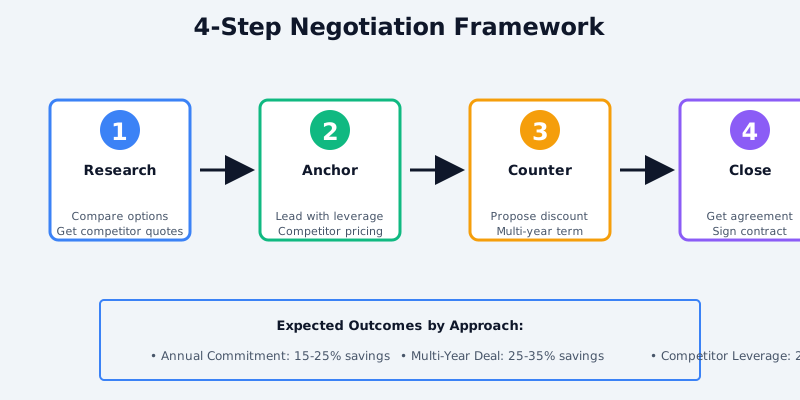
Here is the step-by-step process:
Step 1: Build your baseline (1 week before negotiation)
- Audit current usage and costs
- Research alternatives on CompareTiers catalog
- Get at least one competitor quote
Step 2: Reach out to your vendor (60 days before renewal or when starting evaluation)
- Schedule a call with your account manager or sales contact
- Say: "We love your tool, but we are evaluating whether we can optimize our spend. Can we discuss renewal terms?"
- Ask when their fiscal year ends (timing leverage)
Step 3: Lead with leverage (initial call)
- Share competitor pricing
- Mention your growth plans (if relevant)
- Emphasize your positive experience with the tool
- Ask: "What is the best pricing you can offer?"
Step 4: Negotiate the package (follow-up calls)
- Propose annual commitment in exchange for 30-40% discount
- Ask for feature upgrades at your tier
- Request price locks and renewal guarantees
- Get the offer in writing
Step 5: Close and document (final step)
- Confirm all terms in the signed contract, including:
- Exact annual cost
- Price lock period
- Renewal terms and conditions
- Plan downsizing rights
- Early termination clauses (if needed)
- Capture the negotiation result in your software inventory for future reference
How Much Should You Actually Save?
Typical negotiation outcomes:
- Month-to-month baseline: Expect 20-25% discount for switching to annual
- Competitor leverage: Expect 10-30% discount if you bring a competitor quote
- Multi-year commitment: Expect 30-40% discount for 2-3 year upfront payment
- Feature negotiation: Expect one tier upgrade at current pricing
- Volume growth: Expect 15-25% per-seat discount at higher headcounts
- Renewal retention: Expect 10-20% renewal discount if you shop around first
The average team can save 20-40% across their stack by negotiating systematically. That is thousands of dollars per year.
Explore Your Options with CompareTiers
Before negotiating, make sure you are not overpaying for the wrong tool. Use the comparison tool to model pricing across competing solutions - try Slack vs Microsoft Teams or HubSpot vs Salesforce - to ensure you have the right options on the table.
Then negotiate hard, document everything, and remember: the first number the vendor offers is not the market price - it is an anchor. Your job is to move it.
Sources and References
- Gartner IT Contract Negotiation - Enterprise software contract negotiation best practices
- SaaStr Pricing Strategy - SaaS pricing benchmarks and discount rate analysis
- Vendr SaaS Buying Report - Aggregated data on SaaS contract negotiation outcomes and average discounts achieved
- Zylo SaaS Management Report - SaaS sprawl statistics and cost optimization strategies
- Harvard Business Review on Negotiation - Research-backed negotiation frameworks applicable to vendor contracts