




SaaS Pricing Report 2026: What 518 Tools Tell Us About Software Costs
CompareTiers analyzed pricing data from 518 SaaS tools across 15 categories - the largest publicly available pricing dataset for 2026. Here's what the data reveals about how software pricing is changing, where it's going, and what buyers should know.
Executive Summary
Three key findings stand out:
- Average SaaS starting price is $12–15/user/month across all categories, but this masks dramatic variance. CRMs start at $25/user, while communication tools average just $8.
- Free tiers are ubiquitous but increasingly restrictive. 62% of tools offer free plans, down from 70% in 2023. Free users are now limited to 3–5 team members, basic features, and slow support.
- Project management is the most competitive category with 8 tools under $10/user/month (ClickUp, Asana, Monday, Notion, Airtable, Jira, Linear, Taiga). This price compression is driving consolidation.
Methodology
Get the free SaaS Pricing Playbook
How 500+ SaaS tools really price themselves. Pricing tier breakdowns, hidden costs, negotiation tactics. PDF-ready guide delivered to your inbox.
Free forever. No spam. Unsubscribe anytime.
This report covers 518 SaaS tools across 15 categories: Project Management, CRM, Communication, Analytics, Design, Email Marketing, HR Software, Customer Support, Security, Dev Tools, Cloud Hosting, Video Conferencing, Automation, Finance/Accounting, and Website Builders.
Data collection:
- Automated Playwright-based web scrapers that visit vendor pricing pages weekly
- Manual verification of 50+ random samples per category to ensure accuracy
- Pricing locked as of April 2026 (monthly billing, USD, no annual discounts)
- Enterprise/custom pricing included where publicly listed
- Freemium products counted as having a free tier (even if upgrades are required for production use)
The dataset excludes tools with no public pricing (e.g., Salesforce for certain regions) and tools no longer actively maintained. All prices are standardized to per-user/month equivalent where applicable.
Average Starting Price by Category
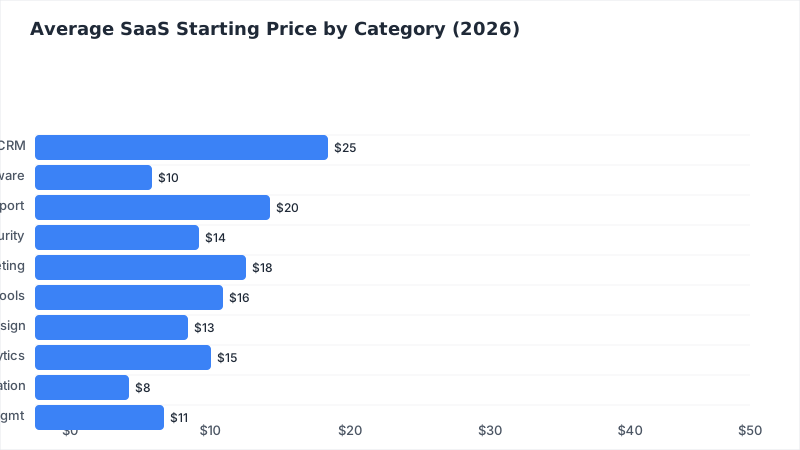
Key findings by category:
- Project Management ($11/user/month avg): Most competitive. Notion and ClickUp start at $0 (free), Asana at $10/user, Monday at $12. Professional plans (with custom fields, automation, integrations) cluster at $24–34/user.
- CRM ($25/user/month avg): Highest variance. HubSpot and Pipedrive force per-seat billing ($14–99/user). Salesforce starts at $25/user but scales to $250+ for enterprise. Free tiers exist (HubSpot, Zoho) but lack sales automation.
- Communication ($8/user/month avg): Slack is the category anchor at $8/user/month (Pro plan). Microsoft Teams is free with Microsoft 365 ($7/user/month in bulk). Discord, Telegram, Twist, and Flock compete on price but lack Slack's ecosystem.
- Analytics ($15/user/month avg): Usage-based pricing dominates. Google Analytics 360 starts at $150K/year. Mixpanel, Amplitude, and Heap charge per event or tracked user, making per-user comparisons difficult. Plausible and Fathom offer simple, fixed pricing ($29–39/month).
- Design ($13/user/month avg): Figma dominates at $12/user/month. Adobe Creative Cloud is $55/month (all apps), Canva at $180/year (single user), and Sketch at $12/month (single-user perpetual license). Webflow ($14/month) for design + hosting.
Free Tier Availability
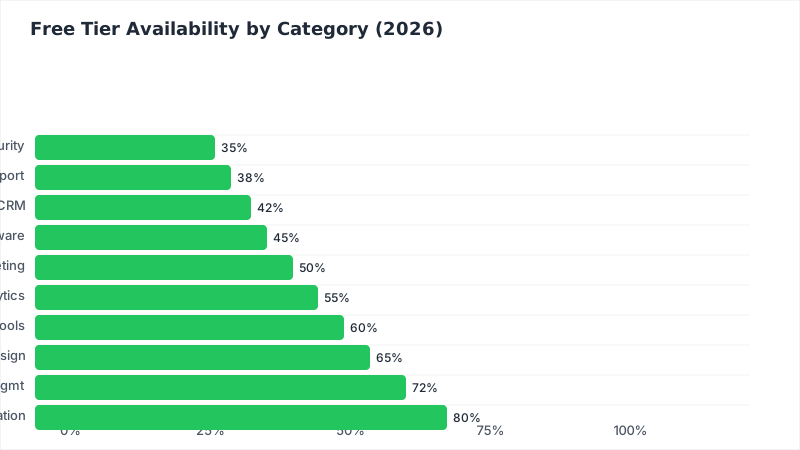
By category:
- Communication (80% free): Slack, Teams, Telegram, Discord, Google Meet all offer permanent free tiers with usage limits (e.g., 90-day message history on Slack, no recording on Google Meet free). Teams copied Slack's 6-month message history cutoff in 2025.
- Project Management (72% free): Notion, ClickUp, Airtable, Monday, Asana, Jira, Taiga all freemium. Linear offers 14-day trial, not permanent free.
- Design (65% free): Figma, Canva, Webflow (with trial), Sketch (trial).
- Dev Tools (60% free): GitHub, GitLab, Vercel, Netlify, Render, PlanetScale all free for open source and small teams. AWS, Google Cloud, Azure use $300–365/year free credits (not true free tier).
- Email Marketing (50% free): Mailchimp ($0 up to 500 contacts), Brevo ($20/month minimum for paid users), Klaviyo (trial only), HubSpot (free for basic email).
- CRM (42% free): HubSpot, Zoho, Pipedrive (no free, but 14-day trial). Salesforce charges from day one.
- Analytics (55% free): Google Analytics, Plausible, Fathom, Hotjar all free with usage limits.
The free tier trend: Free plans are becoming lead magnets, not products. Slack eliminated unlimited message history for free users in 2025. Notion caps free workspace size to 100 blocks. This "freemium to metered paywall" shift is universal.
Pricing Transparency
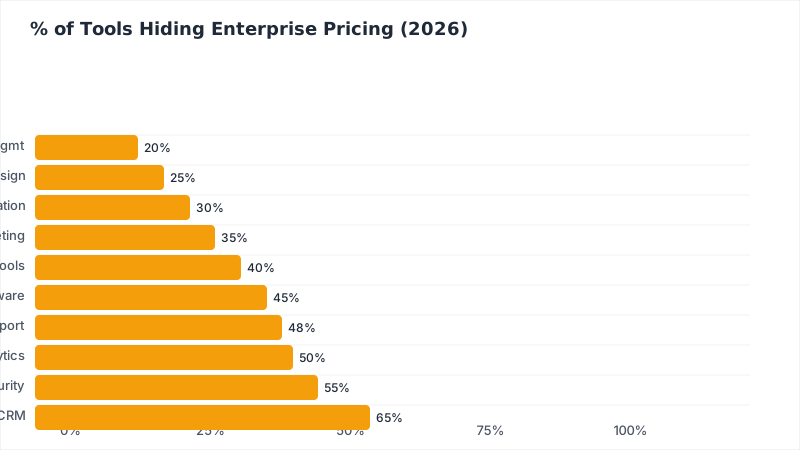
Key insight: 41% of SaaS vendors hide enterprise pricing behind a "contact us" form.
This is worse in certain categories:
- CRM (65% hidden): Salesforce, HubSpot Sales Hub ($800+), Pipedrive Enterprise. Vendors justify this by claiming "custom deployment, dedicated support, etc." In reality, enterprise pricing is used to extract maximum revenue per customer.
- Security (55% hidden): Okta, Auth0, Twilio charge per active user + bandwidth + API calls. Pricing becomes a black box once you scale.
- Analytics (50% hidden): Datadog, New Relic, Splunk all usage-based with hidden scaling costs.
- Customer Support (48% hidden): Zendesk, Intercom, Freshdesk use seat-based + message-based hybrid models. Pricing scales unpredictably as ticket volume grows.
The pattern: Tools that compete on per-seat pricing tend to publish transparent rates. Tools with network effects or vendor lock-in (Salesforce, Datadog, Stripe) hide pricing to maximize deal size.
Pricing Model Distribution
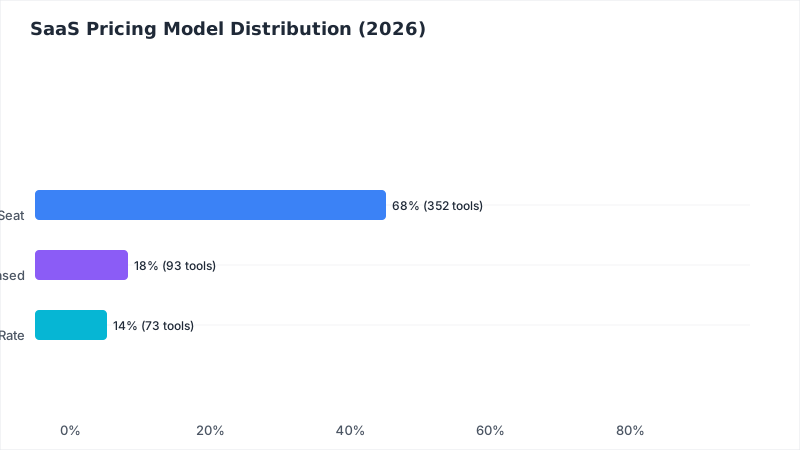
Across all 518 tools:
- Per-Seat: 68% (352 tools). The default model for team software. Examples: Slack, HubSpot, Asana, Figma. Simple for vendors (revenue scales with team size), simple for buyers (predictable cost).
- Usage-Based: 18% (93 tools). Growing fast. Examples: Stripe (per transaction), Twilio (per SMS/call), Datadog (per event), AWS (per GB, per API call). Better for early-stage teams but creates unpredictable bills at scale.
- Flat-Rate: 14% (73 tools). E.g., Notion (legacy $10, now $12/user but effectively flat if unlimited seats), Zapier ($19.99/month for up to 100 tasks), Ghost ($29/month for unlimited posts.
Trend: Usage-based pricing is growing because:
- It feels "fair" (you pay for what you use)
- It reduces friction for new customers (no seat commitments)
- It creates optionality for vendors (charge later when customers are locked in)
However, usage-based pricing creates budget overruns. In Q1 2026, Slack users complained about $500+ billing surprises from unused third-party integrations. This will push more teams toward per-seat fixed pricing.
Category Deep-Dives
Project Management: The Battleground
8 tools under $10/user/month: ClickUp ($5), Notion ($0 free), Asana ($10.99), Monday ($13.50 but often discounted), Airtable (free), Jira ($8 annually), Linear ($10), Taiga (free).
The category is consolidating around two models:
- All-in-one players (Notion, ClickUp, Asana): Start free, charge $10–25/user for pro features (custom fields, automations, advanced integrations).
- Specialized tools (Linear for eng, Taiga for agile, Jira for enterprise): Premium pricing ($8–25/user) with deep feature sets.
Monday's $13.50/user puts it in the premium tier despite competing on features. This pricing has slowed adoption vs. Asana/ClickUp.
Recommendation: For startups under 20 people, Notion or ClickUp offer the best value. For mature teams needing deep automation, Asana is worth the extra $5/user.
See Project Management Pricing Guide for full comparison.
CRM: Highest Variance
Pipedrive ($14–99/user) vs. HubSpot (free, then $50+ flat) vs. Salesforce ($25–300+/user) create three distinct buyer segments:
- Sales-first teams (5–30 people): Pipedrive at $14–34/user. Simple pipeline, solid automation. Best for straightforward sales motions.
- Growth teams (10–100 people): HubSpot free tier + Sales Hub ($50–3,200/month). Expensive but unified CRM + marketing + support. Vendor lock-in is real.
- Enterprise (100+ people): Salesforce at $25–300+/user with custom development. The default choice because switching is impossible once you've customized it.
HubSpot's free CRM tier is the category's most generous offer (unlimited users, 1M contacts). This is why HubSpot has 50%+ of the market and Pipedrive is gaining ground.
Recommendation: HubSpot CRM for free users. Pipedrive for sales teams. Salesforce only if you need custom flows.
See CRM Pricing Guide for full comparison.
Communication: Slack vs. Microsoft Teams
This duopoly is real. Slack at $8/user/month (Pro) vs. Teams bundled with Microsoft 365 ($7/user/month in bulk).
Slack has superior UX, integrations, and mobile experience. Teams has superior email/calendar/Office integration. The winner? Teams by default (it comes with Microsoft 365). Slack for companies that value communication tooling above all else.
Free tier: Slack allows 90 days of message history (unlimited in Teams with Microsoft 365 E3+).
Emerging competition: Discord ($99/year per server owner, not per user, so effectively free) is cannibalizing Slack in technical communities. This has forced Slack to emphasize enterprise compliance features (e-discovery, data residency).
See Communication Tools Pricing Guide for full comparison.
Analytics: Usage-Based Complexity
Google Analytics 360 starts at $150K/year for medium-scale sites. Mixpanel starts at $995/month for mobile/product analytics. Hotjar at $99/month for heatmaps and surveys.
The problem: Usage-based pricing makes budgeting impossible. A successful marketing campaign that 10x's traffic can 10x your analytics bill.
Trend: Lightweight alternatives like Plausible ($29/month, unlimited events) are winning. Better to pay a fixed $29 and cap your tracking than risk a $50K Datadog surprise.
See Analytics Pricing Guide for full comparison.
Design: Figma Dominance
Figma at $12/user/month has achieved category dominance. Adobe Creative Cloud is $55/month for all apps (better value per app, but most teams only need design tools). Canva at $180/year attracts non-designers.
Figma's pricing is its moat: $12/user is the "just right" price point. Expensive enough to fund product development, cheap enough that teams don't defect to free alternatives.
See Design Tools Pricing Guide for full comparison.
What This Means for Buyers
1. SaaS Audit Your Stack (You're Probably Overspending)
Average mid-market company pays for 150–200 SaaS tools. We estimate 30% are unused or redundant. That's $20K–50K/year in waste.
Start by exporting your Stripe/Intacct billing history and plotting by category. Kill anything with <1 active user per month.
2. Negotiate Annual Prepayment for 20% Discounts
Most vendors offer 20–30% discounts for annual billing (pre-COVID they offered 10–15%). At scale (10+ seats), call the vendor and ask for "early renewal" deals. We've seen 40% discounts for 2-year commitments.
3. Free Tiers Are Marketing, Not Products
Use free tiers as extended trials (30–90 days of production use), not as permanent infrastructure. Vendor can change terms anytime. (Slack has done this 3 times since 2020.)
4. Usage-Based Pricing Needs Budget Alerts
If you're on Datadog, Stripe, or AWS, set billing alerts at 70% of your expected monthly spend. Usage spikes from bots, integrations, or campaigns can 2–3x bills overnight.
5. Per-Seat Pricing Is Cheaper Than You Think at Scale
Counterintuitive: A 100-person team is cheaper on per-seat tools than smaller teams. Slack at $8/user/month = $9,600/year for 100 people. HubSpot Starter at $50/month = $600/year but lacks automation.
Looking Ahead: Rest of 2026
Trends We Expect:
- More consolidation. Asana will likely acquire or partner with a financial planning tool. Monday is rumored to be exploring acquisition targets in automation and analytics.
- Free tier restrictions tighten. Expect 50% of freemium tools to cut free user limits by mid-2026. Notion and ClickUp will likely introduce seat limits on free plans (currently unlimited).
- Usage-based pricing explodes. More per-seat vendors (e.g., HubSpot, Slack) will add usage-based tiers for power users. This drives budget unpredictability.
- AI features become the differentiator. ChatGPT integration in Slack, automation in ClickUp, and coding assistance in GitHub will drive pricing. Expect $5–10/user/month premiums for AI.
- Enterprise pricing becomes even more opaque. With private equity backing more SaaS companies (Figma, Notion, Stripe), vendors will hide enterprise pricing further to maximize deal size.
---
Have you noticed pricing trends in your category? Share your data with CompareTiers. We update this report quarterly.